

Cat Ba Island is the largest island in Halong Bay, sitting about 150 km southeast of Hanoi and reachable in roughly 3 hours by bus and speedboat. It is the smart base for travellers who want Halong Bay scenery without an overnight cruise, plus a national park, kayaking in Lan Ha Bay, and three beaches in walking distance of town. The honest version of Cat Ba is: the island is excellent, Cat Ba Town is not. This guide tells you how to plan around that.
Cat Ba gives you the same limestone karst scenery as Halong Bay at a fraction of the price, with the bonus of land-based activities you cannot get on a cruise: hiking in Cat Ba National Park, swimming at Cat Co beaches, and full-day boat tours of Lan Ha Bay for around 500,000 VND (~20 USD).
The island is part of the Halong Bay - Cat Ba Archipelago UNESCO World Heritage Site, inscribed in 2023. Roughly half of its 262 km² is protected national park, home to the critically endangered Cat Ba langur (fewer than 100 individuals left). You will not see one. Almost nobody does. But the forest, caves, and viewpoints are the reason to come.
.jpg)
Plan 2 days for the highlights, 3 days if you want a slow morning and a hike. More than 3 days is for people who specifically came for rock climbing or diving.
Cat Ba splits cleanly into water activities (Lan Ha Bay) and land activities (national park, caves, beaches). Most travellers spend one full day on the bay and one day moving around the island. Below are the things that are actually worth the time.
This is the single best reason to come to Cat Ba. Lan Ha Bay borders Halong Bay to the south and looks identical: same emerald water, same karsts, dramatically fewer boats. A full-day tour usually runs 8:00 to 16:00, costs 450,000 to 600,000 VND (~18-24 USD), and includes lunch, kayaking, and a swim stop.
Book at a Cat Ba Town agency the day before rather than online: dock-side prices are 30-40% lower than 12Go or Klook for the same boats. Group size matters more than itinerary, so ask how many passengers the boat takes (under 25 is comfortable, 30+ feels crowded).
.jpg)
The classic short hike is to Ngu Lam Peak (~1 hour up, hard for the last 20 minutes, sandals will fail). Entry is 80,000 VND (~3 USD). The view at the top covers the forested interior, not the sea. If you want a longer day, the 9 km Viet Hai Village trek crosses the park to a quiet fishing village on the east coast, where you can grab a boat back to town.
.jpg)
A converted limestone cave used as a wartime hospital from 1965 to 1975, 10 km from Cat Ba Town on the road to the national park. Entry is 40,000 VND (~1.50 USD). 30 minutes is enough. The cave itself is dark and concrete, but the wartime context is real and the guide commentary (basic English available) is worth it if you have not seen many Vietnam War sites.
.jpg)
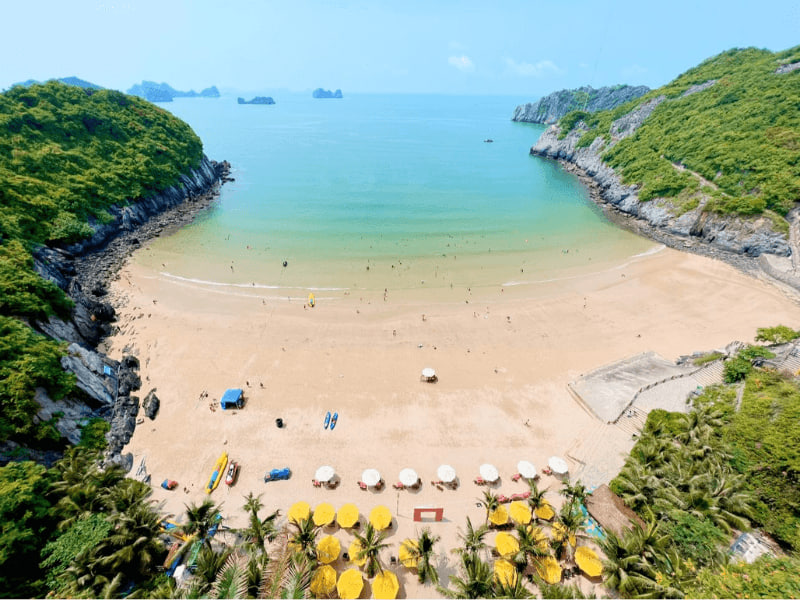
Three small cove beaches connected by a clifftop walkway, 10-15 minutes from Cat Ba Town. Cat Co 1 is the busiest and has bars. Cat Co 2 is the quietest and the best for a read or a swim. Cat Co 3 is dominated by a resort but is still public-access. None of them are world-class beaches. Treat them as a half-day break, not a destination.
💡 Sondax tip:
Skip Monkey Island. The boat tour operators sell it as "playful monkeys on a beach". The monkeys are aggressive, bite, and have been known to steal phones. The beach is fine, but you can swim somewhere else.
The fastest and most reliable option from Hanoi is a bus + speedboat combo ticket, which runs door-to-door in 3 to 3.25 hours for 250,000 to 300,000 VND (~10-12 USD) per person. It includes hotel pickup in the Old Quarter, the highway leg to Got Terminal in Hai Phong, the 10-minute speedboat across the bay, and a transfer bus to your hotel in Cat Ba Town.
Reputable operators include Good Morning Cat Ba, Cat Ba Express, and Daiichi Travel. Book one day ahead.
| Option | Price (one-way) | Duration | Best for |
|---|---|---|---|
| Standard bus + speedboat | 250,000 VND (~10 USD) | 3-3.25 hrs | Budget, solo travellers |
| VIP limousine bus + speedboat | 400,000 VND (~16 USD) | 3-3.25 hrs | Couples, more legroom |
| Private car + ferry | 2,500,000-5,000,000 VND (~100-200 USD) per car | 3-4 hrs | Families of 3-4, groups with luggage |
| Train to Hai Phong + boat | ~150,000 VND (~6 USD) total | 4.5-5 hrs | Train enthusiasts only |
The train option (Long Bien Station to Hai Phong, then taxi to Binh Wharf, then speedboat) is cheaper on paper but adds two transfers and at least an hour of waiting. Not worth it unless you genuinely want the train ride.
Private transfer makes sense for 3 or more passengers, late arrivals, or anyone with heavy luggage who does not want to manage the speedboat transition. Sondax runs private transfers from any Hanoi hotel direct to your Cat Ba accommodation with English-speaking drivers and no shared boat wait.
.jpg)
For the full breakdown of routes and operators see our Hanoi to Cat Ba transfer guide.
Cat Ba Town has the most hotels, restaurants, and tour operators, but it is the least pleasant part of the island: a strip of 5 to 12-storey concrete hotels along a narrow harbour, busy in summer, dead from December to February. Most independent reviewers agree that staying outside town is the better choice if you have a car or motorbike.
Three areas to consider:
Cai Beo floating village south of town has a handful of stilt-house homestays. Charming, but the water quality has slipped in recent years. Read recent reviews before booking.
.jpg)
Rent a motorbike: 120,000 to 150,000 VND (~5-6 USD) per day from any guesthouse in Cat Ba Town. Roads are quiet, paved, and well-marked. This is by far the best way to reach the national park, Hospital Cave, and the northern beaches without paying for a tour.
If you do not ride, taxis are available but expensive and need haggling. Most attractions can also be reached as part of a 1-day "island tour" sold by every agency for around 400,000 VND (~16 USD) per person, which includes Hospital Cave, the national park trail, and a beach stop. Fine value if you do not want to ride.
Cat Ba is a seafood island. The fish, squid, and shellfish are caught locally and served at a fraction of Hanoi prices.
Skip the touristy restaurants on the main harbour road with photo menus and waiters waving you in. Walk one block back to Vien Duong on Nui Ngoc street or Phuong Nhung near the market for the same fresh seafood at 30-40% lower prices. Order by weight (priced per 100g), watch the staff weigh it in front of you, and confirm the total before they cook.
For breakfast, banh mi and bun bo stalls open from 6:00 along 1/4 Street. The local specialty is banh da cua, a red noodle soup with crab from neighbouring Hai Phong, served at most morning eateries for 35,000-50,000 VND (~1.40-2 USD).
.jpg)
The two sweet spots are late April to early June and September to mid-October. Weather is warm and stable, the sea is calm enough to swim and kayak, and the school-holiday peak (June to August) has not yet arrived or has just ended.
July and August give you reliable hot beach weather but also bring domestic tourist crowds, marked-up hotel rates, and the risk of typhoons cancelling boat tours. November to February is cold (12-18°C), often grey, and many smaller hotels close for the season. The landscape still looks striking under cloud, but swimming is uncomfortable.
.jpg)
For region-wide planning see our guide to the best time to visit Vietnam.
The short answer: if you have 2 days and want the iconic photo, do a Halong Bay overnight cruise. If you have 3+ days, want to mix the bay with hiking and beaches, or you want the Halong scenery at half the price, base yourself on Cat Ba and do a day tour of Lan Ha Bay.
Lan Ha Bay shares the same limestone karsts and emerald water as Halong Bay. Visually, you cannot tell them apart on a photo. The difference is that Halong Bay carries roughly 500 cruise boats and Lan Ha Bay carries roughly 50 day boats, so Lan Ha feels quieter and the water is cleaner.
.jpg)
You can also combine the two: a day cruise on Lan Ha Bay from Cat Ba often routes through the southern edge of Halong Bay, so you tick both. Full breakdown in our Halong Bay travel guide.
A short list of things that catch first-timers out.
CTA TA
How many days do you need on Cat Ba Island?
Two full days is the minimum that does justice to the island: one day on a Lan Ha Bay boat tour, one day on land for the national park, Hospital Cave, and a beach. Three days lets you add a slower morning and either a longer trek or a second boat trip.
Is Cat Ba better than Halong Bay?
Neither is "better", they are different. Cat Ba is land-based, more active, cheaper, and quieter. Halong Bay is cruise-based, more polished, more iconic, and busier. For first-timers with 2 days, Halong Bay is easier. For travellers with 3+ days or a tighter budget, Cat Ba wins.
Can you visit Cat Ba on a day trip from Hanoi?
Technically yes (3 hours each way + a Lan Ha Bay tour) but it is exhausting and you will see almost none of the island. If you only have one day from Hanoi, do a Halong Bay day cruise instead. Cat Ba is worth doing properly or not at all.
Is Cat Ba Island safe?
Yes. Petty theft is rare, beaches are supervised in summer, and the main risks are road accidents (wear a helmet on the motorbike) and getting separated from your group on a hike. The cliffside path between Cat Co beaches is well-lit but can be slippery after rain.
Are there ATMs on Cat Ba?
Yes, several in Cat Ba Town along 1/4 Street, but they sometimes run out of cash on holiday weekends. Bring enough cash from Hanoi to cover boat tours and meals (about 2,000,000 VND / 80 USD for 2 days) as a backup.
Can you visit Cat Ba in winter?
You can, but it is cold (12-18°C from December to February), often grey, and most beach activities are closed. Choose winter only if you specifically want quiet trekking weather. Swimming and kayaking are uncomfortable.
Best visited during dry season (November to April) for ideal weather.
Book accommodations in advance during peak travel season.
Carry local currency (Vietnamese Dong) for markets and small vendors.
Respect local customs and dress modestly when visiting temples.