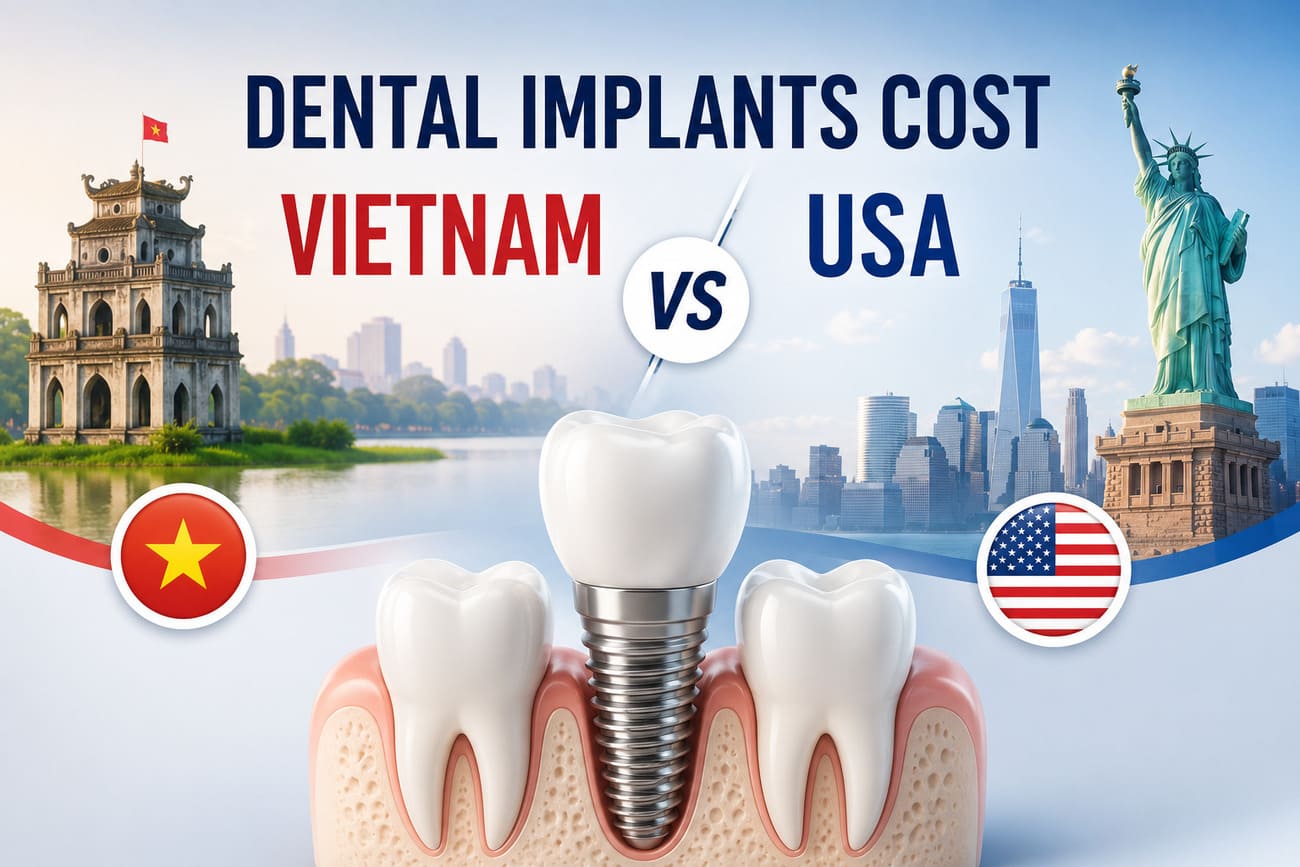
A single dental implant in the USA costs $3,000 to $6,000 including the titanium post, abutment, and crown. The same procedure in Vietnam, using the same globally branded implant systems, costs $700 to $1,500, a saving of roughly 60-75%. After accounting for flights and accommodation, dental travel often offers the greatest savings for patients requiring multiple implants or full-arch treatment. The comparison below breaks down the costs to help you decide whether travelling to Vietnam makes financial sense for your situation.
Quick comparison: dental implant cost in Vietnam vs USA
Dental implant treatment generally costs less in Vietnam than in the United States, although the difference varies by implant system, treatment complexity, and what is included in the quoted package. According to published 2026 price lists from accredited clinics in Vietnam and ADA fee surveys in the US, patients save 60-75% on implant treatment in Vietnam. The table below compares all-inclusive prices (implant post, abutment, and crown) for the most common procedures.
| Procedure |
Vietnam |
USA |
Typical saving |
| Single implant (Korean system: Osstem/Dentium) |
~$700-$1,000 |
$3,000-$5,000 |
70-80% |
| Single implant (Swiss: Straumann/Nobel Biocare) |
~$1,200-$1,800 |
$4,000-$6,000 |
60-70% |
| All-on-4 (per arch) |
~$4,500-$9,200 |
$18,000-$35,000 |
65-75% |
| Full mouth (both arches) |
~$10,000-$18,000 |
$35,000-$70,000+ |
70-75% |
| Bone graft (if needed) |
~$150-$400 |
$800-$3,500 |
70-85% |
Sources: ADA fee data 2025-2026, Aspen Dental 2026 internal data, CareCredit national average 2026, Picasso Dental/Elite Dental/DentalTrip Vietnam published 2026 price lists. Vietnam prices are all-inclusive (fixture + abutment + crown + CBCT scan + consultation). US prices are typically all-inclusive ranges. Exact prices confirmed with the hospital before booking.
Why the price difference is not a quality difference
The lower cost of dental implant treatment in Vietnam is largely driven by lower operating expenses rather than differences in the cost of internationally recognised implant systems. For example, a Straumann implant placed in Hanoi uses the same Swiss-manufactured implant components as one placed in New York.
The components that determine clinical outcomes, including the titanium implant fixture, prosthetic restoration, and diagnostic imaging like CBCT scanner, represent an estimated 40-55% of the total treatment fee in Vietnam, according to a 2026 cost analysis by Picasso Dental Clinic (Picasso Dental Clinic, 2026).
By comparison, it suggests that operating costs account for a larger proportion of treatment fees in the United States because of higher labour, rent, insurance, and administrative expenses.
Vietnamese dentists complete their training at accredited medical universities, and many pursue postgraduate education or continuing professional development both locally and internationally. Many clinics serving international patients use modern technologies widely adopted in implant dentistry, including CBCT 3D imaging, digital treatment planning, intraoral scanners, and CAD/CAM crown milling.
Dentist salaries and overall clinic operating costs are generally lower in Vietnam than in the United States, contributing to lower treatment fees alongside lower facility and administrative expenses. These lower overheads allow many clinics to offer more competitive pricing while using the same recognised implant brands and modern clinical technologies. For example, a Straumann implant placed in Vietnam is the same manufacturer-supplied product used in clinics worldwide, including the United States, Australia, and Europe.
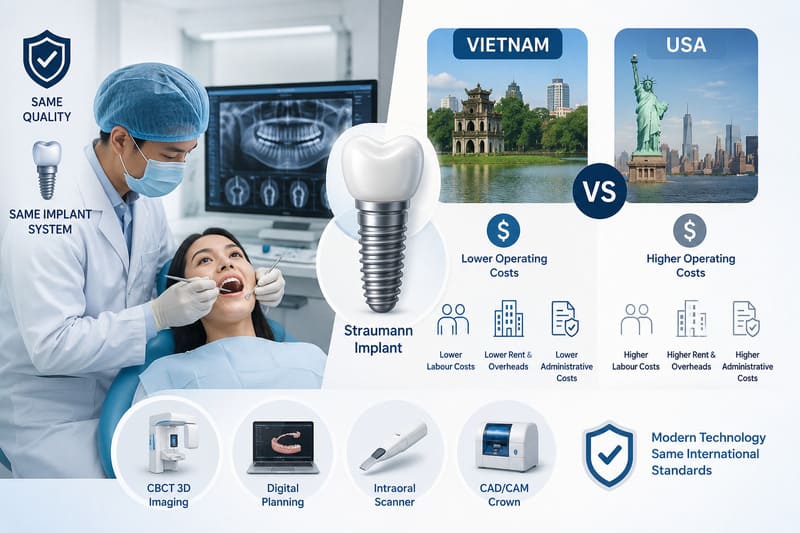
In other words, patients are often paying less because operating costs are lower, not because the implant system itself is different.
Implant brands available in Vietnam
Reputable Vietnamese clinics offer the same globally recognised implant systems found in US dental offices. The three tiers below cover most cases. Your dentist will recommend a system based on bone condition, jaw position, and how many implants you need. All major brands come with manufacturer-backed warranties.
| Tier |
Brand |
Origin |
Vietnam price (single, all-in) |
Manufacturer warranty |
| Premium |
Straumann |
Switzerland |
~$1,400-$1,800 |
Lifetime (fixture + abutment) |
| Premium |
Nobel Biocare |
Sweden/Switzerland |
~$1,200-$1,600 |
Lifetime (fixture + abutment) |
| Mid-range |
Osstem |
South Korea |
~$700-$1,000 |
~10 years (Manufacturer warranty varies) |
| Mid-range |
Dentium |
South Korea/USA |
~$450-$980 |
~10 years (Manufacturer warranty varies) |
Sources: Straumann Guarantee Program (straumann.com), Nobel Biocare Warranty Program (nobelbiocare.com), published Vietnam clinic price lists 2026. Manufacturer warranty covers the fixture; the crown warranty (typically 5-10 years) is set by the clinic.
What to know:
Always ask for the specific brand and model before treatment starts. A reputable clinic will provide the implant serial number and an "implant passport" for your records. If a clinic quotes "Korean brand" without naming it, or declines to provide documentation, ask for further clarification before proceeding. Insist on a named system with a traceable serial number.
Total trip cost: what you actually pay
A dental implant in Vietnam usually requires two trips: the first for placement (5-10 days), and a return visit 3-6 months later for the final crown (5-7 days). Some clinics offer immediate provisional teeth for selected All-on-4 cases. However, most single-implant treatments follow a two-visit protocol, with the final crown placed after a 3-6-month healing period.
Below is a realistic budget for an American patient travelling from the West Coast.
| Cost item |
1 implant (Osstem) |
1 implant (Straumann) |
All-on-4 (one arch, Straumann) |
| Treatment |
~$800 |
~$1,500 |
~$8,000 |
| Round-trip flights (x2 trips) |
~$1,600-$2,000 |
~$1,600-$2,000 |
~$1,600-$2,000 |
| Accommodation (12-17 nights total) |
~$600-$1,000 |
~$600-$1,000 |
~$600-$1,000 |
| Food and local transport |
~$300-$500 |
~$300-$500 |
~$300-$500 |
| Total (Vietnam) |
~$3,300-$4,300 |
~$4,000-$5,000 |
~$10,500-$11,500 |
| Same treatment in the USA |
$3,000-$5,000 |
$4,000-$6,000 |
$18,000-$35,000 |
Flight estimates based on Momondo and Skyscanner data, Jun 2026 (round-trip US West Coast to Hanoi/HCMC, economy). Accommodation at a $50-$80/night mid-range hotel. Exchange rate: 1 USD ≈ 25,400 VND.
For a single implant with a mid-range Korean brand, the total trip cost roughly equals the US price, no dramatic savings. The math shifts decisively in Vietnam's favour, starting at two implants, where you save $2,000 or more. For full-arch cases, the savings after travel often exceed $10,000-$20,000.
Is the quality the same?
When the implant brand, the surgical protocol, and the dentist's training are equivalent, clinical outcomes depend primarily on factors such as treatment planning, clinician experience, implant system, patient factors, and long-term maintenance rather than the country itself. A 2024 meta-analysis published in Clinical Oral Investigations (Kupka et al.) covering 20 years of data found average implant survival rates of 94-97.8%. A 2025 Israeli dental registry tracking 158,824 implants in 53,874 patients reported a 97.8% survival rate. These data demonstrate the high long-term predictability of modern implant therapy when evidence-based protocols are followed.
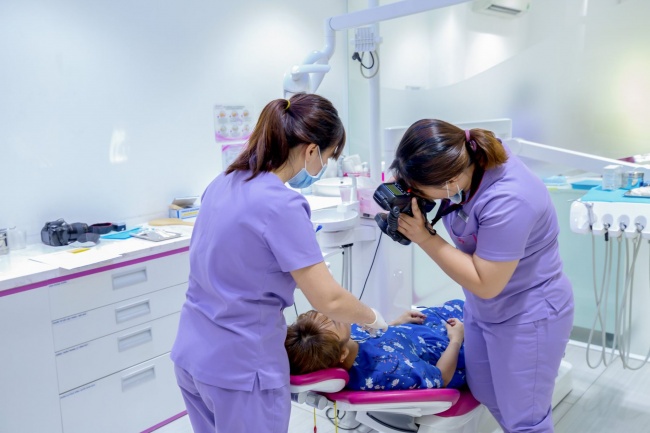
Several Vietnamese clinics hold international accreditation. For example, Elite Dental in Ho Chi Minh City received accreditation from the American Accreditation Commission International (AACI) in 2025, scoring 95.33 out of 100. Accreditation means the clinic meets independently verified standards for sterilisation, infection control, clinical protocols, and patient safety.
However, accreditation and quality standards vary between clinics. The quality gap between a premium accredited clinic and a budget storefront can be significant. Your choice of provider matters more than your choice of country. For a full breakdown of how to evaluate Vietnamese dental clinics, procedures, and what to expect, see our guide to dental work in Vietnam.
Hidden costs to budget for
The comparison table above covers the core implant package, but additional procedures can add to your bill in both countries. In the US, a bone graft adds $800-$3,500 per site, a sinus lift $1,500-$4,500, and IV sedation $500-$1,500. In Vietnam, the same add-ons cost roughly 70-85% less: bone grafts run $150-$400, and sedation is typically $50-$150. These add-ons are quoted separately in both countries, so always request an itemised treatment plan before committing.
Beyond the clinical bill, consider these often-overlooked costs when comparing your options:
| Hidden cost |
USA |
Vietnam |
| Temporary crown (during healing) |
Often included or $200-$500 |
Usually included in the package |
| CBCT 3D scan |
$300-$600 (sometimes billed separately) |
Typically included in the package |
| Consultation fee |
$100-$350 |
Free or waived on treatment |
| Follow-up X-rays (annual) |
Covered by a local dentist |
Done locally at home, or on a follow-up visit |
| Revision if the implant fails |
Covered by clinic warranty (varies) |
Covered by clinic warranty, but requires travel |
The highest hidden cost of choosing Vietnam is the warranty logistics.
If an eligible Straumann implant component fails under the manufacturer's warranty programme, the component may be replaced in accordance with the manufacturer's warranty terms through participating authorised providers.
However, warranties generally do not cover the clinical costs of replacing a crown, revising implant positioning, performing additional bone grafting, or travel expenses. If further treatment is required after you return home, you may need to revisit the original clinic or arrange ongoing care with a local dentist.
This is a real trade-off. Ask your Vietnam clinic about their specific revision policy and warranty terms before booking.
Pros and cons of each option
Getting implants in the USA
You have easier access to follow-up care and can see your dentist without booking flights. Some dental insurance plans may contribute towards implant treatment, although many have annual benefit limits of approximately USD 1,000-2,000 and may not cover implants in full.
Getting implants in Vietnam
The primary advantage of travelling to Vietnam for dental implants is the potential cost savings, particularly for patients requiring multiple implants or full-arch rehabilitation.
Many clinics serving international patients use internationally recognised implant systems and modern digital workflows comparable to those used in the United States.
Some patients combine treatment with travel, recovering in Da Nang or exploring Hanoi between appointments. The drawbacks are real: most conventional implant treatments require two visits. Follow-up care may involve either a return trip or coordination with US dentists, and manufacturer warranties apply only to eligible implant components. Any revision of the clinical work, such as the crown, bone graft, or implant restoration, is generally managed according to the clinic's warranty and aftercare policy.
.jpg)
Who should choose Vietnam (and who should not)
Vietnam makes strong financial sense if you need two or more implants, any full-arch restoration, or a combination of implant and cosmetic work (veneers, crowns) that bundles under the same trip. Patients already planning to visit Vietnam, for example, to visit family or for business, may find it more cost-effective to combine treatment with their trip. Patients from the West Coast benefit from shorter flights (15-18 hours with one stop via Seoul, Tokyo, or Taipei) and lower fares than East Coast travellers.
Dental tourism is generally most cost-effective for higher-value treatment plans. At that level, the savings comfortably exceed all travel costs. For full-mouth All-on-4 treatment, where costs in the United States may reach USD 35,000-70,000, patients may save an estimated USD 15,000-30,000 by having treatment in Vietnam, even after accounting for flights and accommodation. If you are already planning a Vietnam trip for any reason, adding dental work to the itinerary makes the decision even simpler.
When Vietnam may not be the right choice:
If you need a single straightforward implant and your dental plan contributes around $1,500-2,000, your out-of-pocket cost at home may be comparable to the total Vietnam trip cost. Patients with complex medical histories (uncontrolled diabetes, heavy smoking, ongoing bisphosphonate therapy) should work closely with their local specialist rather than coordinating care across two countries. If the idea of two international trips for dental work feels stressful rather than exciting, choosing treatment locally is a reasonable option.
How the process works if you choose Vietnam
Most international patients follow a six-step process: share your dental X-ray or CT scan online for a remote consultation, receive a written treatment plan with an itemised treatment plan and quotation, fly to Vietnam for the first appointment (CBCT scan, placement, a temporary restoration, where clinically appropriate), return home for the 3-6 month healing period while the implant integrates with your jawbone, fly back for the final crown placement (5-7 days), then continue routine check-ups with your local US dentist. English-speaking coordinators at established clinics handle scheduling, airport fast-track, and hospital transport, so you do not need to navigate logistics in a foreign language.
If you need a Vietnam e-visa, processing takes about 3 business days and costs $25 for a 30-day single entry. For longer treatment plans (especially IVF or multi-stage dental work), you may need to extend your visa in-country. US citizens are also eligible for 45-day visa-free entry as of 2023, which is more than enough for either implant trip. Visa requirements may change. Check the latest guidance from the Vietnam Immigration Department before travelling.
FAQ
How much does a single dental implant cost in Vietnam vs the USA?
In Vietnam, a single implant (fixture + abutment + crown) costs $700-$1,800 depending on the brand. In the USA, the same procedure costs $3,000-$6,000. The price difference is driven by lower operating costs in Vietnam, not by different materials. Many clinics in both countries use the same Straumann, Nobel Biocare, and Osstem implant systems.
Do I need two trips to Vietnam for dental implants?
In most cases, yes. The first trip (5-10 days) covers the implant placement. You then return home for 3-6 months while the implant fuses with your jawbone. The second trip (5-7 days) is for the final crown. Some patients undergoing full-arch treatment cases allow provisional teeth on the same day, but a return visit for the permanent bridge is still typical.
Is it safe to get dental implants in Vietnam?
At accredited clinics using globally branded implant systems, yes. Peer-reviewed studies report implant survival rates of 95-98% at five years, regardless of country, when the procedure is performed by a trained implantologist with proper imaging and sterile protocols. The key is choosing the right clinic. Look for international accreditation, named implant brands, written warranties, and documented serial numbers. For a detailed breakdown, see our guide on whether dental work in Vietnam is safe.
Can I use US dental insurance for treatment in Vietnam?
Most US dental insurance plans do not cover treatment performed outside the country. However, given that typical US plans cap annual benefits at $1,000-$2,000 (against a $3,000-$6,000 implant), the insurance offset is often modest. Some patients submit receipts for partial reimbursement; check with your specific plan. Even without insurance, the Vietnam price plus travel usually costs less than the US out-of-pocket price.
What implant brands do Vietnamese clinics use?
Leading clinics stock the same global brands used in American practices: Straumann (Switzerland), Nobel Biocare (Sweden/Switzerland), Osstem (South Korea), Dentium (South Korea/USA), and Neodent (Brazil, part of the Straumann Group). Premium brands offer long-term or lifetime warranties on eligible implant components, subject to their warranty terms. Always confirm the brand in writing before treatment and request the implant serial number for your records.
Can I combine dental implants with a holiday in Vietnam?
Yes, and many patients do. After the implant placement, you typically wait 1-2 days before travelling comfortably; however, recovery varies between individuals, and your dentist will advise when it is appropriate to travel. The remaining days of your trip can be spent recovering while exploring Hanoi, Ho Chi Minh City, or beach destinations like Da Nang. Between the two required trips, you effectively get two holidays. Budget around $20-$40 per day for meals and local transport in Vietnam, a fraction of daily costs in the US. Some patients time their second trip around Tet or other festivals to make the return visit more memorable.
Get an itemised quote for dental implants in Vietnam
Our team confirms package prices with the hospitals or clinics and sends you a detailed, line-by-line quote in English, including the implant brand, crown material, and any add-ons. No commitment, no surprises. Start here.