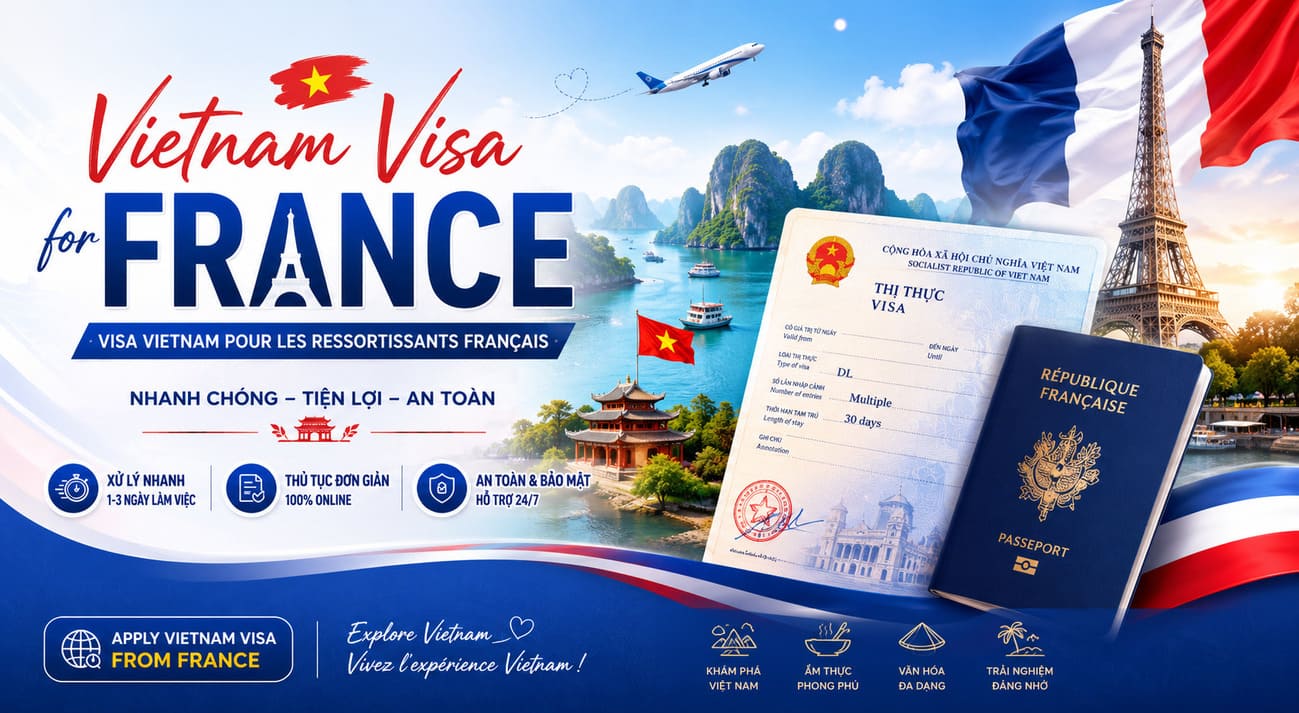
French citizens do not need a visa for Vietnam if their stay is 45 days or less. This visa exemption runs under Resolution 44/NQ-CP, valid from March 15, 2025 to March 14, 2028. Staying longer than 45 days, or want extra flexibility? You'll need an e-visa, which costs 25 USD (~635,000 VND) for single entry and takes 3-7 business days
No, not for stays up to 45 days. France is one of 12 countries on Vietnam's unilateral visa exemption list, alongside Germany, Italy, Spain, the UK, and others. The exemption applies regardless of passport type or trip purpose (tourism, business, family visits), as long as you meet basic entry conditions.
To use this 45-day exemption, your French passport needs:
💡 Sondax tip:
The 45-day exemption resets every time you leave and re-enter Vietnam, with no minimum gap required between visits. Some travelers do a quick visa run to Cambodia or Thailand specifically to refresh the clock instead of paying for an e-visa. It works, but factor in 1-2 extra flight costs.
.jpg)
If your trip runs past 45 days, you have three realistic options: the e-visa, visa on arrival (air travel only), or a sticker visa from the Vietnamese embassy in Paris. The e-visa is what almost everyone uses now: it covers land, air, and sea entry, and skips the embassy trip entirely.
| Option | Max stay | Fee | Processing time | Entry points |
|---|---|---|---|---|
| E-visa (single entry) | 90 days | 25 USD (~635,000 VND) | 3-7 business days | Air, land, sea |
| E-visa (multiple entry) | 90 days | 50 USD (~1,270,000 VND) | 3-7 business days | Air, land, sea |
| Visa on arrival | 30-90 days | 25 USD + stamp fee at airport | 3-5 business days for approval letter | Air only |
| Embassy sticker visa (Paris) | 30-90 days | 40-100 USD depending on validity | 5-7 business days | Air, land, sea |
Skip the visa-on-arrival route unless you're flying and already have a strong reason to want a pre-approval letter (some group bookings still default to it). For everyone else, the e-visa is faster, cheaper, and works at more entry points.
.jpg)
Apply directly at evisa.gov.vn, the only official government portal. You'll need a passport scan, a digital photo, and your travel dates. Processing takes 3-7 business days; apply at least 2 weeks before departure to have a buffer for Vietnamese public holidays or system delays.
💡 Sondax tip:
Third-party visa agencies routinely charge 2-3x the official fee for "express" processing you don't actually need. The government portal itself is the cheapest and most reliable route. Only pay extra if you're applying inside 5 business days of travel and genuinely need urgent processing.
.jpg)
Starting July 1, 2026, every traveler entering, leaving, or transiting Vietnam must complete a health declaration under Decree 165/2026/ND-CP, regardless of nationality or visa status. This is separate from your visa or e-visa and separate from the Digital Arrival Card used at some airports. It must be filed within 7 days before you cross any Vietnamese border checkpoint, by air, land, or sea.
As of late June 2026, the official online portal for this declaration hadn't been published yet. Until it goes live, border posts accept a paper form (Appendix V of Decree 165), available from airlines and at the immigration hall. Bring proof of vaccination if you have it; officers can request it, though it's not mandatory for most travelers.
This adds one more checkpoint at immigration, on top of your e-visa or visa exemption stamp. If you're connecting onward at Tan Son Nhat or Noi Bai during peak hours, that extra step can stretch a routine queue. Sondax's airport fast-track service puts an English-speaking agent next to you at the priority lane, so a missing form or a flagged declaration doesn't push you to the back of the line.
.jpg)
Most rejections and delays come from a handful of avoidable errors, not policy itself.
If you're staying beyond 45 days and want to extend without leaving the country, see our guide on extending a Vietnam visa.
.jpg)
Do Vietnamese citizens need a visa for France?
Yes. Vietnam is not on France's visa-exemption list, so Vietnamese passport holders need a Schengen visa for any stay in France under 90 days, and a long-stay visa for longer trips. Applications go through TLS Contact centers in Hanoi or Ho Chi Minh City on behalf of the French consulate.
Do EU passport holders need a visa for Vietnam?
It depends on the country, not just on holding an EU passport. France, Germany, Italy, Spain, Denmark, Sweden, Finland, Belgium, the Netherlands, Poland, and several other EU members get 45 days visa-free. Others, like Ireland or Portugal, are not on the exemption list and need an e-visa for any stay. Check your specific nationality before assuming EU membership alone covers you.
You can live in Vietnam long-term, but Vietnam has no dedicated retirement visa as of 2026. Most retirees stay through repeated 90-day e-visas with periodic visa runs, an investor visa (minimum capital required), or a spouse-based residence card if married to a Vietnamese citizen. None of these are visa-free options like the 45-day tourist exemption.
What happens if I overstay my 45-day exemption?
Overstay fines run roughly 10-50 USD per day, and longer overstays can mean detention or an entry ban on future trips. There's no grace period built into the exemption, so track your 45th day from your actual arrival stamp, not your booking date.
.jpg)
Best visited during dry season (November to April) for ideal weather.
Book accommodations in advance during peak travel season.
Carry local currency (Vietnamese Dong) for markets and small vendors.
Respect local customs and dress modestly when visiting temples.

Noi Bai International Airport, Hanoi
Walk past the immigration queue at Noi Bai Airport. A dedicated Sondax escort guides you through priority lanes - typically done in under 20 minutes.

Tan Son Nhat, Ho Chi Minh City
Beat the immigration queue at Tan Son Nhat Airport. Our team escorts you through priority lanes — arrival or departure done in under 30 minutes.

Nha Trang, Vietnam
Priority immigration clearance at Cam Ranh International Airport. Quick entry to Nha Trang.

Da Nang, Vietnam
Priority immigration clearance at Da Nang International Airport. Skip the queue and clear immigration quickly.

Phu Quoc, Vietnam
Priority immigration clearance at Phu Quoc International Airport. Fast entry to paradise island.