
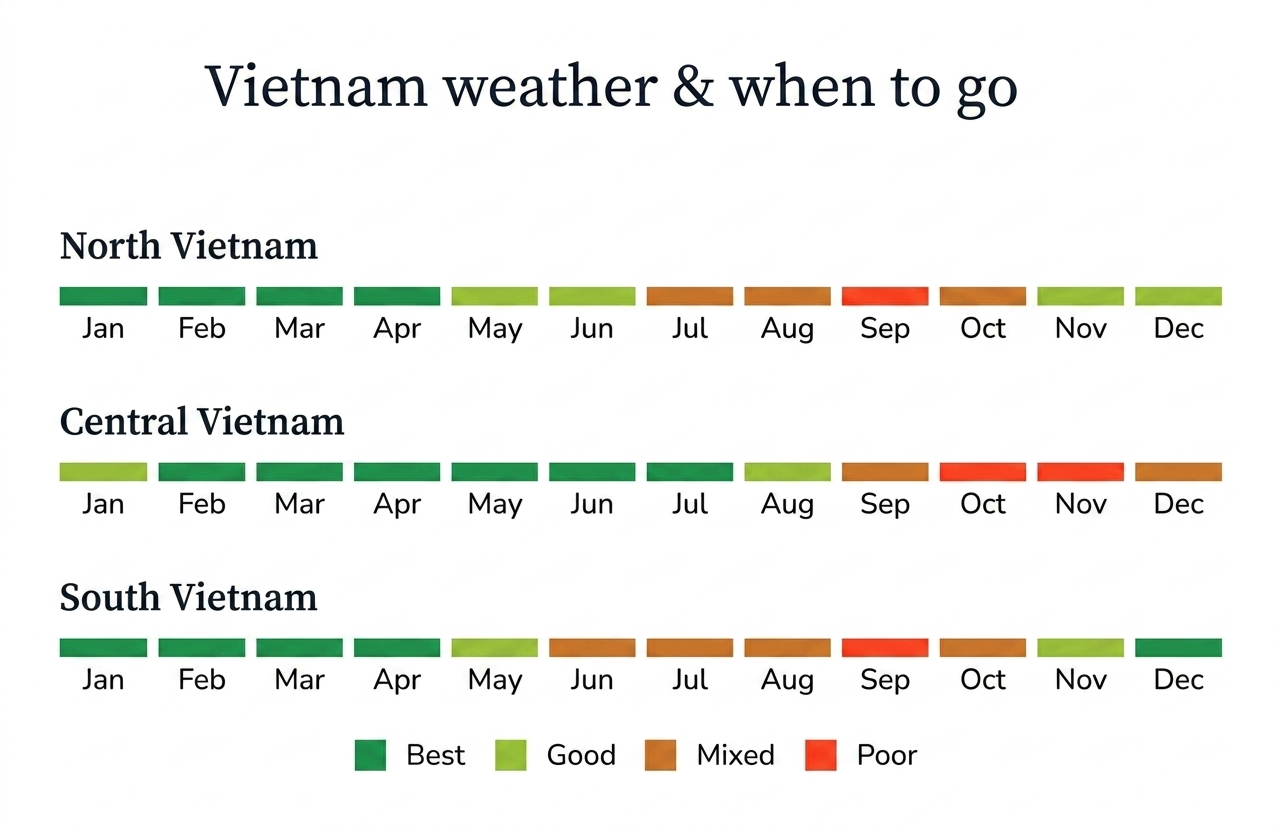
The best time to visit Vietnam is from March to April, the only stretch when the north, the centre and the south are all mostly dry and warm at once. If you are visiting one region, go to the north in October to November or March to April, the centre from February to August, and the south from December to April. Vietnam runs about 1,650 km from north to south, so there is always a region with good weather; the trick is matching the route to the month.
The short version
Vietnam has three weather zones. The north has four seasons with a cool, dry winter; the central coast is dry from February to August and wet from September to December; the south is hot all year, with a dry season from December to April. The table below gives the best and worst months for each, with typical daytime temperatures from long-term averages.
| Region | Best months | Months to avoid | Typical day / night |
|---|---|---|---|
| North: Hanoi, Ha Long Bay, Ninh Binh, Sapa, Ha Giang | October to November, March to April | June to August (heat, heavy rain, typhoon risk) | 20 / 14°C in January, 34 / 27°C in June |
| Central: Hue, Hoi An, Da Nang, Quy Nhon | February to May (beach season runs to August) | October to November (floods, storms) | 25 / 19°C in January, 34 / 26°C in June |
| South: Ho Chi Minh City, Mekong Delta, Phu Quoc | December to April | September to October (heaviest rain) | 32 to 35 / 23 to 26°C all year |
Sources: monthly climate normals for Hanoi (Lang station, 1991 to 2020), Da Nang and Ho Chi Minh City (Tan Son Nhat), Vietnam Institute for Building Science and Technology and WMO. Checked 28 September 2026.
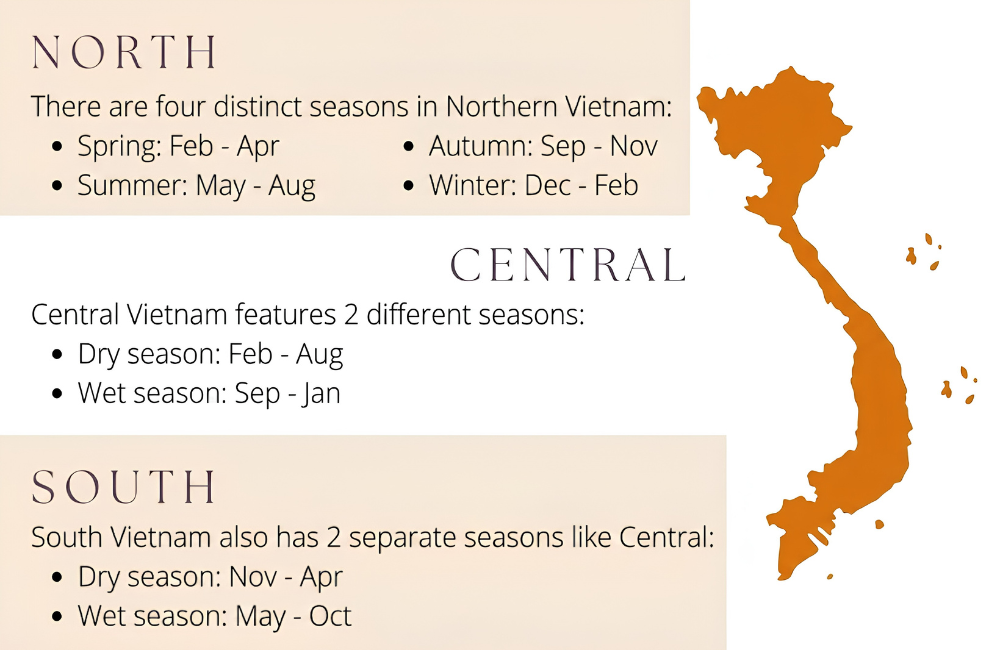
The line between north and central Vietnam is a mountain ridge, not a date on the calendar. The Hai Van Pass, between Hue and Da Nang, blocks much of the winter monsoon, so from November to January it is often grey and wet in Hue while Da Nang and Hoi An, on the other side of the pass, often get sun. The mountains of the far north run on their own clock too: Sapa sits at about 1,500 m and nights can drop close to freezing in January, while Hanoi is still at 14°C.
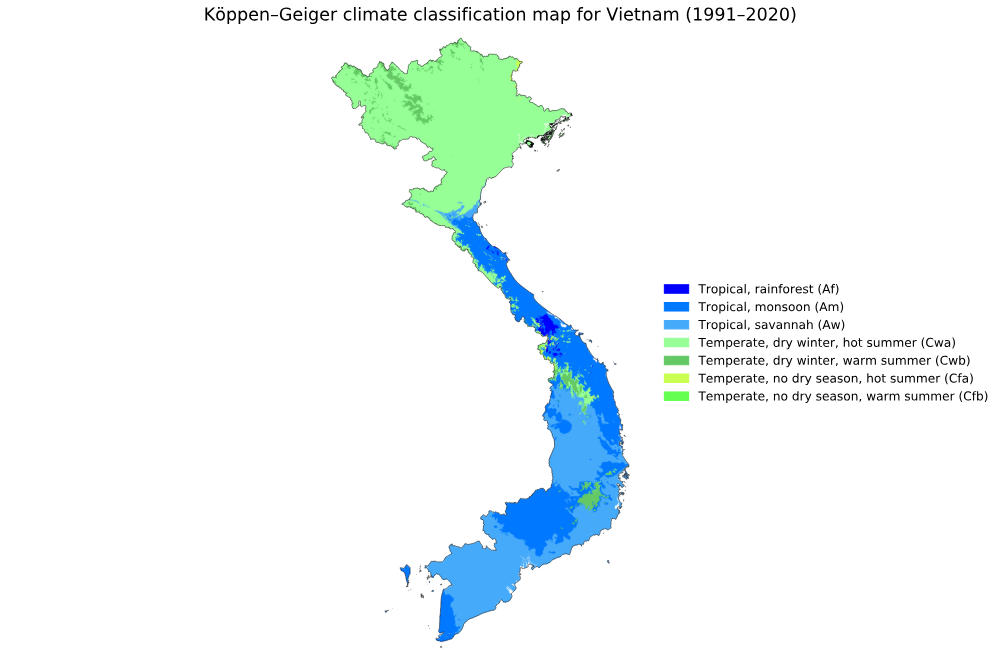
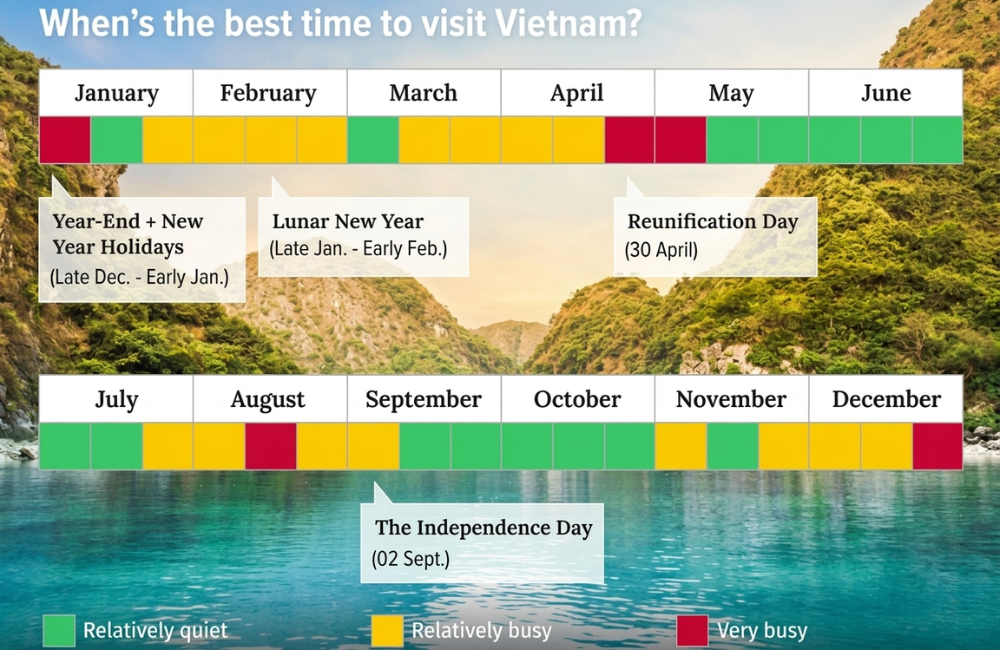
Month by month, Vietnam's weather shifts from dry and cool in the north in winter, to hot and wet in the north and south in summer, and to heavy rain on the central coast in autumn. Use this table to check the month you have, then adjust the route: in almost every month at least one region is at its best.
| Month | North (Hanoi, Ha Long, Sapa) | Central (Hue, Hoi An, Da Nang) | South (Saigon, Mekong, Phu Quoc) |
|---|---|---|---|
| January | Cool and grey, 14 to 20°C; Sapa near freezing at night | Mild, 19 to 25°C, last showers | Dry and sunny, best month |
| February | Cool, light drizzle; Tet crowds | Dry season starts | Dry and sunny |
| March | Warming, 20 to 26°C, drier | Dry, 22 to 28°C, good | Dry and hot |
| April | Pleasant, 22 to 28°C, good | Dry, warm sea, good | Hottest, up to 35°C, late showers |
| May | Hot, first heavy rain | Hot and dry, beach season | Rainy season starts |
| June | Hot, 27 to 35°C, wet | Hot and dry, domestic holiday crowds | Afternoon storms |
| July | Hot and wet, typhoon risk at sea | Hot and dry | Afternoon storms |
| August | Wettest month, about 270 mm | Hot, rain rising late in month | Afternoon storms |
| September | Rain easing; rice terraces turn gold | Rains start, storm risk | Among the wettest months |
| October | Dry and clear, 23 to 30°C, best month | Wettest month, about 630 mm, flood risk | Rain easing |
| November | Dry and clear, 20 to 27°C, good | Still wet, flood risk in Hue and Hoi An | Dry season starts |
| December | Cool, 14 to 21°C | Showers easing, cooler | Dry, sunny, peak season |
Sources: same climate normals as above. Temperatures are average daytime lows to highs; single days vary.
The rainy season in Vietnam runs from May to September in the north, from September to December on the central coast, and from May to November in the south. The typhoon season overlaps it, from about July to November, and hits the north and centre far more often than the south.
Rain means different things in each region. In Ho Chi Minh City it usually arrives as a heavy afternoon storm of an hour or two, and the evening is dry, so a southern trip in the wet season is still very workable. In the north, the risk is storms at sea: from July to September, Ha Long Bay cruises can be cancelled at short notice when the port authority stops departures. On the central coast, October and November bring days of continuous rain and floods; the Thu Bon River regularly rises into Hoi An's old town. For region-by-region detail, see our guide to the Vietnam rainy season.
.jpg)
If a rainy day catches you, every big city has good indoor options: the water puppet theatre and the Fine Arts Museum in Hanoi, lantern-making and cooking classes in Hoi An, and the War Remnants Museum and Central Post Office in Ho Chi Minh City. Buy a thick plastic poncho from a street stall for the price of a coffee; it does better than an umbrella on the back of a motorbike.
.jpg)
For trekking in Sapa or Ha Giang, go from September to November or March to May; for beaches, choose Da Nang and Hoi An from February to August or Phu Quoc from November to April; for Ha Long Bay, March to May and September to November give the calmest seas. Each activity has its own window, which is why a single "best month" rarely fits a whole trip.
.jpg)
.jpg)
Tet, the Lunar New Year, is the holiday that affects travel most: in 2027 it falls on 6 February, and trains, flights and hotels fill for about two weeks around it. Other busy dates are the 30 April and 1 May holidays, National Day on 2 September, and the Christmas to New Year week. A festival can also be the reason to go.
| Event | When | What to know |
|---|---|---|
| Tet (Lunar New Year) | 6 February 2027; 26 January 2028 | Flower markets and family feasts; many small shops close for several days, transport is full |
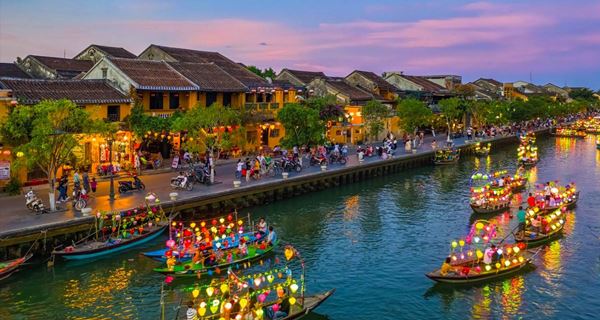
| Hoi An full moon night | 14th day of every lunar month | Lanterns on the Thu Bon River, old town crowded in the evening |
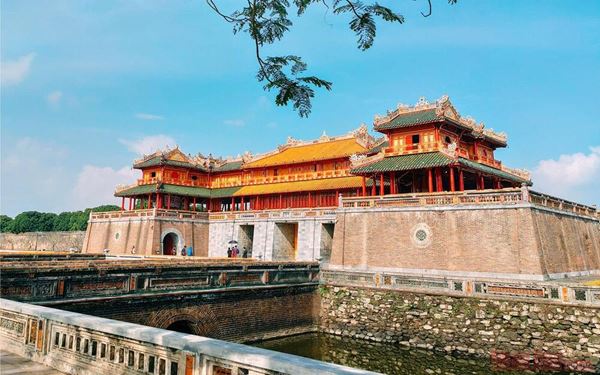
| Hue Festival | Programme spread across four seasons | Heritage shows and royal court music; check dates on the festival website |
| Mid-Autumn Festival | 15 September 2027 | Lantern parades and mooncakes, liveliest around Hang Ma Street in Hanoi |
.jpg)
The cheapest time to visit Vietnam is May to September, outside the domestic summer peak weeks, when foreign arrivals drop and hotels and cruises cut prices to fill rooms. The trade-off is heat and rain in the north and south, although the central coast is dry and at its beach best in exactly these months.
June to September also brings some of the greenest landscapes of the year, from Ban Gioc waterfall to the rivers of Trang An, and Hoi An's lanterns look the same in any season. We always tell friends coming in summer to plan outdoor sightseeing before 10 am and after 4 pm; the middle of the day in Hanoi in July is for a long lunch and an air-conditioned museum. If you want a route built around the months you have, our Vietnam tours are planned region by region with the weather in mind, and our guide to summer in Vietnam covers the hot months in more detail.

What is the best month to visit Vietnam?
April is the best single month for a trip through the whole country: the north is warm and fairly dry at 22 to 28°C, the central coast is dry, and the south is still in its dry season. March is a close second, a little cooler in the north. Book early if your trip overlaps the 30 April holiday.
What is the worst time to visit Vietnam?
There is no month when the whole country is bad, but October and November are the riskiest months for the central coast, with the heaviest rain and floods in Hue and Hoi An. July to September is the main typhoon window for the north, including Ha Long Bay, and Tet week is the hardest time for transport.
Is December a good time to visit Vietnam?
Yes, especially for the south, which is dry and sunny with highs around 31°C. Hanoi is cool, 14 to 21°C, so bring a light jacket, and nights in Sapa and Ha Giang can drop near freezing. The central coast is still showery early in the month, and Christmas to New Year is peak season.
When is the best time to visit Ha Long Bay?
March to May and September to November give the calmest seas and clearest views of Ha Long Bay. December to February is cool and often misty, and July to September carries a risk of storm cancellations, when the port authority halts sailings at short notice.

---Related Articles---
Best visited during dry season (November to April) for ideal weather.
Book accommodations in advance during peak travel season.
Carry local currency (Vietnamese Dong) for markets and small vendors.
Respect local customs and dress modestly when visiting temples.






Phu Quoc International Airport, Phu Quoc
A Sondax host meets your group inside Terminal 2 at Phu Quoc and walks you to the priority immigration lane, on arrival or departure.

Da Nang International Airport, Da Nang
A Sondax host meets your group inside the international terminal at Da Nang and walks you to the priority immigration lane.

Cam Ranh International Airport, Nha Trang
A Sondax host meets your group inside Terminal 2 at Cam Ranh and takes you to the priority immigration lane, arrival or departure.

Tan Son Nhat, Ho Chi Minh City
A Sondax host meets your group inside the terminal at Tan Son Nhat and walks you straight to the priority immigration lane.

Noi Bai International Airport, Hanoi
A Sondax host meets your group inside Terminal 2 at Noi Bai and walks you past the queue to the priority immigration lane.