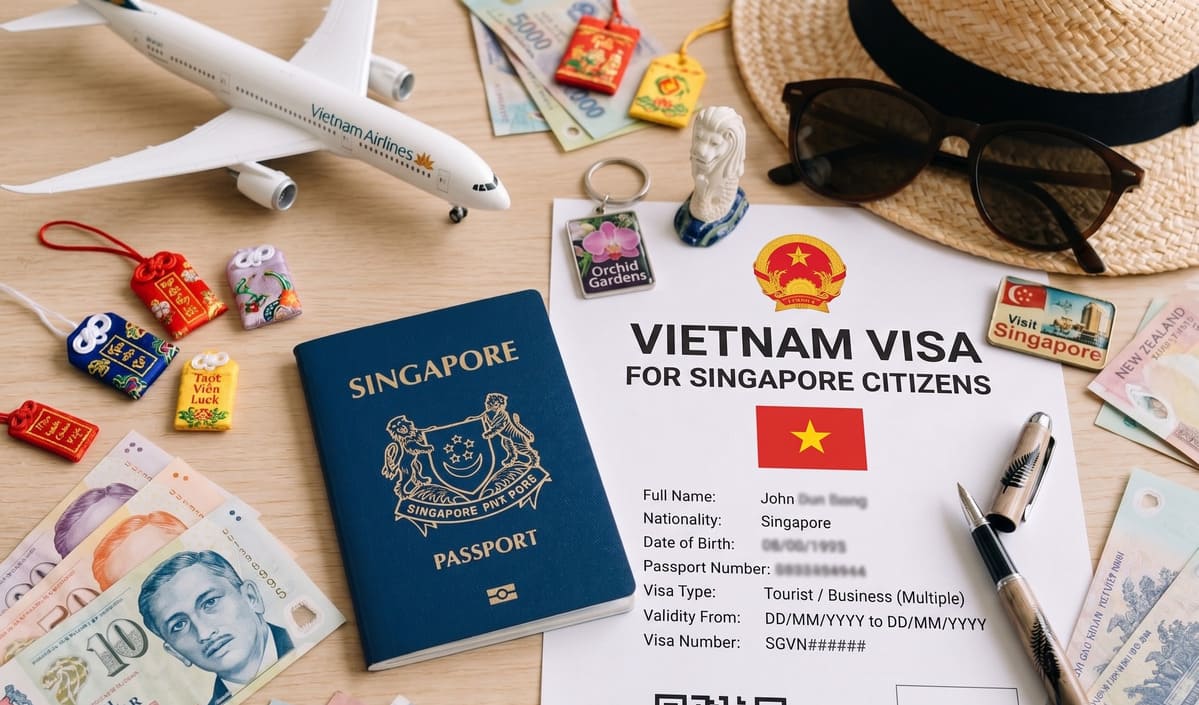

A Vietnam visa for Singaporeans is not required for stays of up to 30 days per entry, but you still need a passport valid for 6 months and, at the main airports, a free online arrival card; for a longer stay you need an e-visa, which costs $25 for a single entry and is valid for up to 90 days. This guide covers the Vietnam visa for Singapore citizens: the 30-day rule, the arrival card, the e-visa, fines and re-entry.
The short version
No. Singapore passport holders can enter Vietnam without a visa and stay up to 30 days per entry for tourism, family visits or short business meetings. Entry is at the discretion of Vietnam Immigration, so carry a passport valid for at least 6 months and a return or onward ticket in case the officer asks.
The exemption works at international airports, land border gates such as Moc Bai from Cambodia, and seaports open to foreign visitors. You do not need to apply in advance, and an officer stamps your passport with an entry date at the booth. Most sources also ask for 2 blank pages in the passport, so renew early if yours is nearly full.
.jpg)
Singaporeans can stay up to 30 days per entry, counting the day you arrive as day one. The visa exemption for Singaporeans covers tourism, visiting family and short business meetings, but not paid work or a longer stay, which need the right visa before you fly. The 30 days cannot be extended inside Vietnam.
Overstaying is costly. Under Decree 282/2025, in force since 15 December 2025, foreigners face fines of 500,000 to 2 million VND (about US$19 to US$76) for an overstay under 16 days, 5 to 10 million VND for 16 to under 30 days, and up to 40 million VND at a year or more, with deportation possible. Singapore's Ministry of Foreign Affairs also warns that fines for overstaying have increased.
.jpg)
Yes, at the main airports. Vietnam replaced its paper arrival card with a free online pre-arrival declaration, required at Tan Son Nhat since 15 April 2026 and at Noi Bai since June 2026, for visa-exempt travellers as well as e-visa holders. You file up to 3 days before arrival and show the QR code to the officer.
The form asks for your passport details, flight number, phone, email and the address of your first night. File it on the official portal, prearrival.immigration.gov.vn, because third-party sites that charge a fee are middlemen. Transit passengers who stay airside are exempt, and Da Nang has been announced without a start date, so check the portal before you fly. Our guide to filling in the arrival form before you fly walks through each field.
📌 Insider note:
File the arrival card the day before you fly and screenshot the QR code. Filing at the airport can mean a longer wait at immigration, and mobile data can be slow right after landing.
.jpg)
Singaporeans have two legal routes: apply for an e-visa before you travel, which costs $25 for a single entry or $50 for multiple entries and is valid for up to 90 days, or leave Vietnam before day 30 and re-enter for a new 30-day stay. The e-visa is the safer choice, because re-entry is at the officer's discretion.
An e-visa replaces the 30-day exemption for that trip, so your stay then follows the dates printed on the visa. You apply online in about 6 steps.
Blurry scans and glare over the data page are the usual reasons for a resubmission, which restarts the wait, so apply at least 2 weeks before your flight. Our guide to applying for the e-visa step by step shows each screen.
.jpg)
A visa run means leaving Vietnam before day 30 and re-entering for a fresh 30-day stay, for example by flying to Bangkok or Kuala Lumpur and back, or by bus from Ho Chi Minh City across the Moc Bai border to Cambodia and back. The sources we checked set no fixed gap between exempt stays, but entry stays at the officer's discretion, so keep your onward ticket and accommodation details ready and expect Cambodia's own entry fees at the border.
Do not count on extending inside Vietnam: an e-visa cannot be extended there, and the 30-day exemption cannot either. Read the extension and visa run rules before you plan a long stay on the exemption.
.jpg)
A visa on arrival is not the same as the official e-visa, and Singaporeans rarely need either for a trip under 30 days. It needs an approval letter from an agency before you fly, works only at international airports, and adds a $25 or $50 stamping fee at the counter, while the e-visa is $25 or $50 online.
| Option | Cost | How it works | Watch out for |
|---|---|---|---|
| Visa exemption | Free | 30 days per entry on a Singapore passport | No extension; fines for overstaying |
| E-visa | $25 single entry, $50 multiple entry | Apply online, print the PDF, go to passport control | Fake websites that copy the portal |
| Visa on arrival | Agency fee plus a $25 (single) or $50 (multiple) stamping fee | Approval letter before you fly, then a visa counter at an international airport | Denied boarding without the letter; airports only |
Sources: Ministry of Foreign Affairs Singapore; Vietnam Immigration Department (evisa.gov.vn); Wise New Zealand visa guide (stamping fees); checked October 2026.
.jpg)
Airlines at Changi can refuse boarding if you assume you can buy a visa on arrival like in some other countries, because the letter cannot be issued at the check-in desk. See when visa on arrival still makes sense if your trip is only days away.
The Vietnam Immigration Department, under the Ministry of Public Security, runs the e-visa system at evisa.gov.vn, and the Embassy of Vietnam at 10 Leedon Park handles consular matters in Singapore. A standard tourist e-visa is applied for online, not at the embassy, so contact the embassy only for other documents.
.jpg)
Sort out data and your ride before you land, because you will need both to show your first-night address and book a car. Compare Singtel, StarHub or M1 roaming with a local SIM or eSIM, and use Grab or a pre-booked fixed-price private airport transfer instead of unmarked taxis.
.jpg)
Most Singaporeans start in Ho Chi Minh City, Hanoi or Da Nang, about 2 to 3.5 hours by air. Registration is mandatory: hotels register you with the local police, and if you stay in a private home, your host or landlord does it.
.jpg)
.jpg)
A passport valid for at least 6 months, with blank pages, is the main requirement. You may also be asked for a return or onward ticket and your accommodation address. At Tan Son Nhat and Noi Bai you also need the free online arrival card. No approval letter or hotel printout is required.
Often yes, but it is not guaranteed. The sources we checked list no fixed gap between exempt stays, and entry is at the officer's discretion. If you plan a long stay, an e-visa for up to 90 days avoids relying on re-entry.
Yes. The Embassy of Vietnam is at 10 Leedon Park, Singapore. Most Singaporeans do not need it for a trip under 30 days, and the tourist e-visa is applied for online instead. Contact the embassy for consular documents or questions about long-term stays.
The Singapore Embassy in Hanoi is at 41 and 43 Tran Phu Street (+84 24 3848 9168), and the Consulate-General in Ho Chi Minh City is at Saigon Centre Tower 2, 67 Le Loi Boulevard (+84 28 3822 5174). For a 24-hour line, the MFA Duty Office is +65 6379 8800.
.jpg)
---Related Articles---
Best visited during dry season (November to April) for ideal weather.
Book accommodations in advance during peak travel season.
Carry local currency (Vietnamese Dong) for markets and small vendors.
Respect local customs and dress modestly when visiting temples.