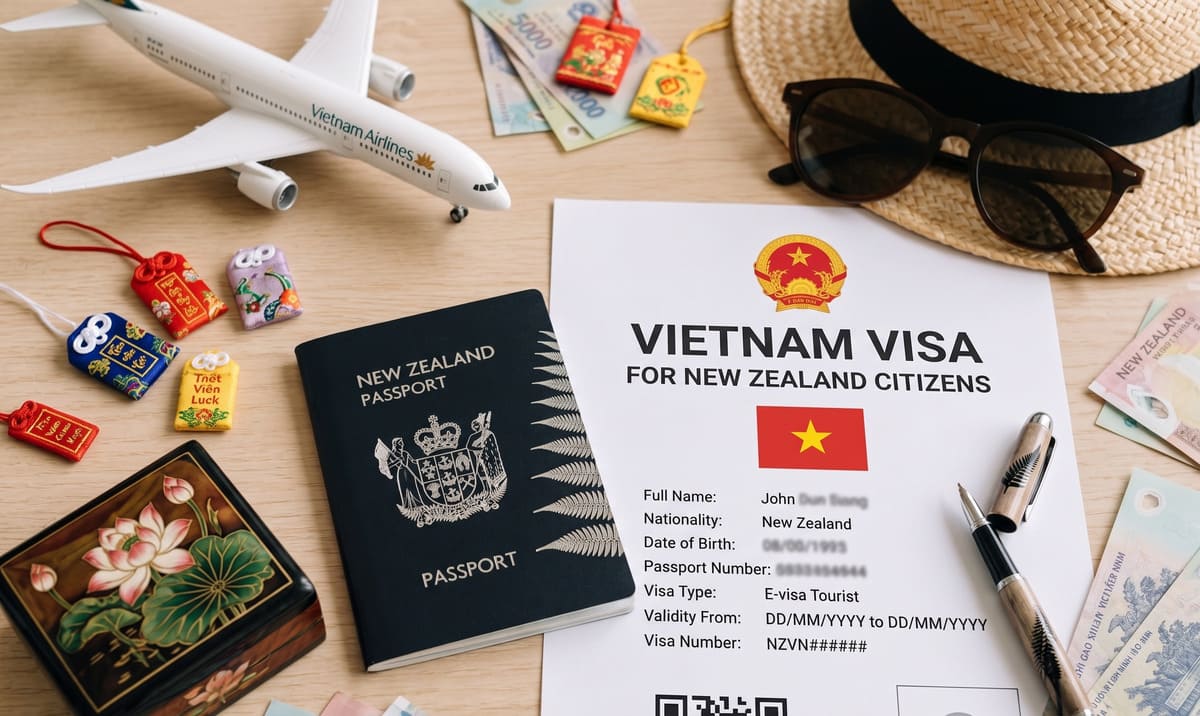

A Vietnam visa for New Zealand citizens is required for every trip, because New Zealand is not on Vietnam's visa-exemption list, and the simplest route is the official e-visa: $25 for a single entry or $50 for multiple entries, valid for up to 90 days and normally issued within 3 working days of a complete application. This guide covers the cost in New Zealand dollars, the application steps, how a visa on arrival compares, and the date and photo errors that hold up applications.
The short version
Yes. New Zealand passport holders need a visa to enter Vietnam for tourism, business or any other purpose, because New Zealand is not on Vietnam's visa-exemption list, which today covers mainly European and Southeast Asian passports. Get approved before you board, and apply online for an e-visa instead of waiting for the airport.
The one exception is Phu Quoc Island, where visitors of any nationality can stay 30 days without a visa if they fly in directly from abroad and stay on the island. Flying on to Ho Chi Minh City or Da Nang means you need a standard visa first, and a connection on the mainland counts as entering Vietnam. Check-in staff at your departure airport, including at a connecting hub, check your visa before issuing a boarding pass.
Dual citizens with a second passport from an exempt country, such as the UK or Germany, can use the 45-day exemption (currently valid until 14 March 2028), but only if they enter and leave Vietnam on that passport.
.jpg)
Your New Zealand passport should be valid for at least 6 months, and the safest reading of the rule is 6 months after the day you leave Vietnam, which also satisfies stricter airline checks. Keep at least 2 blank pages, and type your name and date of birth exactly as printed in the passport, because the e-visa is tied to those details.
The official Vietnam e-visa fee for New Zealand citizens is $25 for a single entry and $50 for multiple entries, charged in US dollars on the government portal, so expect roughly NZ$40 to NZ$45 and NZ$85 to NZ$90 at recent exchange rates. Both are valid for up to 90 days, and neither fee is refunded if the application is rejected.
The portal accepts Visa and Mastercard, and your bank may add a foreign transaction fee. A rejected application means paying again on a fresh one, so check your passport details twice before you pay.
Agencies and lookalike websites charge a service fee on top of the same document, so check that the address you pay on ends in .gov.vn and that checkout shows $25 or $50. The multiple-entry version is worth the extra $25 only if you plan to leave Vietnam and come back, for example on a side trip to Cambodia or Laos.
.jpg)
A Vietnam e-visa for New Zealanders is valid for up to 90 days, counted from the entry date you chose on the application, and it is usually issued within 3 working days. You cannot extend an e-visa inside Vietnam, so a longer stay means leaving and applying again.
The 90 days count your arrival day as day one. A visa that starts on 1 July runs out on 28 September, not on 1 October, and your exit date must fall on or before that last day. Arriving later than the start date does not move the end date.
Overstaying is expensive. Under Decree 282/2025, in force since 15 December 2025, foreigners face fines of 500,000 to 2 million VND (about US$19 to US$76) for an overstay under 16 days, 5 to 10 million VND for 16 to under 30 days, and up to 40 million VND at a year or more, with deportation possible. New Zealand's SafeTravel advice also warns that overstaying can affect your ability to book accommodation. If you need more time, read the extension and visa run rules before your visa expires.
.jpg)
The e-visa fits most New Zealand travellers: it costs $25 or $50, takes about 3 working days and arrives as a PDF, with no airport visa counter. A visa on arrival suits late bookings but needs an approval letter and a stamping fee at the airport, and an embassy visa means dealing with the Embassy of Viet Nam in Wellington.
| Option | Cost | Time | Best for |
|---|---|---|---|
| E-visa | $25 single entry, $50 multiple entry | About 3 working days | Almost every tourist or business trip |
| Visa on arrival | Approval letter fee set by the agency, plus a $25 (single) or $50 (multiple) stamping fee at the airport | Letter issued before you fly; airports only | Late bookings when an e-visa will not arrive in time |
| Embassy visa | Set by the Embassy of Viet Nam in Wellington | Set by the embassy | Travellers who prefer a visa in the passport or cannot use the portal |
Sources: Vietnam Immigration Department (evisa.gov.vn); Wise New Zealand visa guide (updated June 2025); Embassy of Viet Nam in Wellington via NZ MFAT; checked October 2026.
.jpg)
No. A Vietnam visa on arrival is not a walk-up service: New Zealanders must get an approval letter from an authorised agency before they fly, then pay a stamping fee at the visa counter of an international airport. Airlines can refuse boarding without the letter, and it does not work at land borders or seaports.
The letter is issued through Vietnam's Immigration Department, so you pay an agency to request it, then print it and carry it with two 4x6 cm photos and the stamping fee in US dollars. The e-visa is usually simpler, but see when visa on arrival still makes sense if your trip is only days away.
.jpg)
Apply on evisa.gov.vn, the government's official portal. To get a Vietnam visa for New Zealanders online, you upload a portrait photo and a passport scan, enter your details exactly as printed in your passport, choose your entry date and port, and pay by card. The e-visa arrives as a PDF to print.
Our guide to applying for the e-visa step by step shows each screen if you want to compare before you start.
.jpg)
The most common reasons a Vietnam visa for NZ citizens is delayed or refused are wrong passport details, a cropped passport scan, a passport with under 6 months left, applying too close to departure, and arriving at a different port from the one on the visa. Each one means a rejection, a resubmission or a refused boarding.
.jpg)
📌 Insider note:
Check the entry date against your landing time. If your visa starts on the 27th but your flight lands at 11:15 pm on the 26th, you cannot enter, and airlines may refuse to board you. Put your flight times next to the visa dates before you pay.
.jpg)
After landing, follow the signs to foreign passport control, not the landing visa desks, and hand your passport and printed e-visa to the officer. The officer checks the documents, scans your passport and stamps it, and then you collect your bags and pass through customs.
.jpg)
Noi Bai is about 27 km from the Old Quarter, roughly 40 to 60 minutes by road depending on traffic. New Zealand's SafeTravel advice is to pre-book airport transfers or use only legitimate taxis to avoid scams, and the main options are below.
Before you land, compare One NZ, Spark or 2degrees roaming with a local SIM or eSIM, so you can call your ride from the arrivals hall.
.jpg)
Bring a printed copy of your approved e-visa and your New Zealand passport, which should have at least 6 months of validity and blank pages. Enter through the port you listed on the application. Airlines may also ask for proof of onward travel before check-in.
No. An e-visa cannot be extended from inside Vietnam. If you want to stay beyond the 90 days, you must leave the country and apply for a new e-visa, and overstaying instead leads to fines and possible deportation.
Yes. The Embassy of Viet Nam is at Level 21, Grand Plimmer Tower, 2-6 Gilmer Terrace, Wellington 6011. Most New Zealand travellers apply for the e-visa online instead, but you can contact the embassy for its current embassy-visa fee and timing.
The New Zealand Embassy is at Level 5, 63 Ly Thai To Street, Hanoi, and the Consulate-General is at Suite 804, The Metropolitan, 235 Dong Khoi Street, District 1, Ho Chi Minh City. For emergencies from overseas, SafeTravel lists +64 99 20 20 20.
.jpg)
---Related Articles---
Best visited during dry season (November to April) for ideal weather.
Book accommodations in advance during peak travel season.
Carry local currency (Vietnamese Dong) for markets and small vendors.
Respect local customs and dress modestly when visiting temples.