Dental work in Vietnam typically costs 50-70% less than in the United States, Australia, and the United Kingdom. Many clinics use internationally recognised implant systems such as Straumann and Nobel Biocare, along with premium materials like IPS e.max and zirconia, while following internationally accepted sterilisation protocols. Vietnam now receives roughly 79,000 international dental patients a year, with Australian patient numbers growing more than 150% year on year, according to a 2026 Medical Tourism Corporation study. This guide explains what drives the savings, what they buy you, what they don't, and how to avoid the clinics that give dental tourism a bad name.
How much does dental work in Vietnam cost?
The table below shows indicative prices at clinics that serve international patients. These clinics typically offer English-speaking staff, use internationally recognised implant systems, and perform treatment planning with CBCT (cone beam computed tomography) 3D imaging. Prices at local-only clinics may be lower, but they may differ in terms of materials, equipment, treatment protocols, and patient support services. All figures are in USD.
| Procedure |
Vietnam |
USA |
Australia (AUD) |
UK (GBP) |
| Single dental implant (fixture + abutment + crown) |
$700-$1,500 |
$3,000-$5,500 |
$4,000-$7,000 |
£2,500-£4,500 |
| All-on-4 (per arch, fixed bridge) |
$5,500-$9,200 |
$14,000-$36,000 |
$16,000-$35,000 |
£10,000-£20,000 |
| Porcelain veneer (per tooth, E.max) |
$200-$450 |
$1,500-$2,500 |
$1,200-$2,000 |
£600-£1,200 |
| Zirconia crown |
$120-$300 |
$800-$3,000 |
$1,000-$2,000 |
£400-£900 |
| Root canal + crown |
$150-$400 |
$1,500-$3,000 |
$1,500-$3,500 |
£500-£1,200 |
| Metal braces (full treatment) |
$1,000-$2,000 |
$3,000-$7,000 |
$5,000-$9,000 |
£1,500-£3,500 |
| Professional teeth whitening |
$80-$200 |
$500-$1,000 |
$500-$1,000 |
£200-£600 |
Sources: MedicalTourismCo (2026), Elite Dental (2026 Price List), Picasso Dental (2026), DentalRoundup (2025-2026), SmileJet (March 2026). Vietnam prices are for clinics serving international patients using named brands. Final treatment costs should always be confirmed with the clinic before booking.
Lower dental prices in Vietnam are largely driven by reduced operating costs, including labour, clinic overheads, and laboratory fees, rather than by lower-grade materials. Many reputable clinics use the same internationally recognised implant systems and restorative materials available in Australia, the United States, and Europe. For example, a Straumann implant placed in Hanoi is the same Swiss-manufactured titanium fixture as one placed in Melbourne. The lab that mills your zirconia crown may charge $30-$50 in Vietnam versus $200-$400 in the US, but the raw zirconia block is the same product.
What procedures are available
Vietnam's dental tourism industry offers a full range of restorative and cosmetic work. The most common procedures international patients travel for are dental implants (single, multiple, or full-arch All-on-4/All-on-6), porcelain veneers and smile makeovers, crowns and bridges, and root canal treatment. Clinics in Hanoi, Ho Chi Minh City, and Da Nang also offer orthodontic treatment (including metal braces and Invisalign), teeth whitening, wisdom tooth extraction, and full-mouth rehabilitation.
Among these procedures, dental implants and porcelain veneers typically offer the greatest cost savings, making them the most attractive options for international patients. For instance, a patient requiring one implant, two crowns, and a professional cleaning would pay roughly $900-$1,500 total in Vietnam versus $5,000-$9,000 in countries such as the United States or Australia. In many cases, the savings are sufficient to offset the cost of travel and accommodation.
Implant brands: what to ask and why it matters
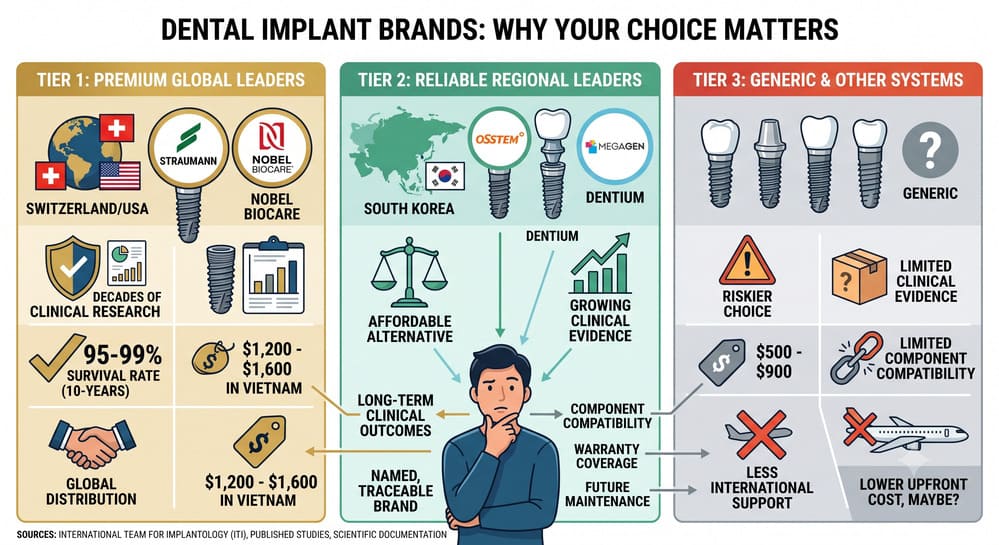
The implant system used during treatment can affect long-term clinical outcomes, component compatibility, warranty coverage, and the availability of replacement parts for future maintenance. Vietnam's market has three tiers, and understanding them is the single most important thing you can do before booking.
Tier 1: Straumann, Nobel Biocare (Switzerland/USA)
Straumann and Nobel Biocare are among the world's most established dental implant manufacturers. Their implant systems are supported by decades of clinical research, extensive long-term follow-up data, and global distribution. Published studies have reported 10-year implant survival rates of approximately 95-99% for these implant systems, although outcomes vary depending on patient factors, surgical technique, and maintenance.
In Vietnam, treatment using these premium implant systems typically costs $1,200-$1,600 per implant, compared with approximately $3,000-$5,500 in the United States or Australia.
Sources: International Team for Implantology (ITI) Consensus Statements; Straumann Scientific Documentation (SLActive®); Albrektsson et al., Clin Implant Dent Relat Res.; Nobel Biocare Scientific Documentation.
Tier 2: Osstem, Dentium, MegaGen (South Korea)
These established Korean implant systems are widely used across Asia and supported by a growing body of clinical evidence. They offer a more affordable, traceable alternative to premium European brands. These cost $500-$900 per implant in Vietnam. A sensible choice for patients on a tighter budget who still want a named, traceable brand.
Tier 3: Generic and other implant systems
Some clinics offer generic or other implant systems from manufacturers with more limited long-term clinical evidence or international distribution. While these systems may reduce the upfront treatment cost, they often come with fewer published clinical studies, more limited component compatibility, and less comprehensive international support compared to well-established brands.
Before proceeding with treatment, ask your clinic which implant system will be used and whether replacement components are readily available in your home country.
What to know:
If a clinic uses only general descriptions such as "premium implant" or "high-quality Korean implant" without identifying the manufacturer, ask for more details.
The right question to ask: "What is the exact brand, product line, and can you provide the serial number and batch certificate after placement?" A clinic that uses Straumann or Nobel Biocare will answer immediately, because those brands are a selling point. Knowing the implant brand and ensuring it is fully traceable can make future maintenance and replacement easier, particularly if you need follow-up care in your home country.
How long do you need to stay in Vietnam?
This depends on the procedure, and the honest answer for implants is longer than most marketing sites tell you.
| Procedure |
Minimum stay |
Total trips |
Note |
| Veneers (6-10 teeth) |
5-10 days |
1 |
Prep, temporaries, lab fabrication, and final bonding. |
| Crowns/bridges |
5-7 days |
1 |
Prep, impressions/scan, lab, fitting. |
| Single implant |
5-7 days (trip 1) + 3-5 days (trip 2) |
2 |
Trip 1: placement. Wait 3-6 months for bone integration. Trip 2: final crown. |
| All-on-4 (full arch) |
7-14 days (trip 1) + 5-7 days (trip 2) |
2 |
Trip 1: surgery + temporary bridge. Wait 3-6 months. Trip 2: final fixed bridge. |
| Teeth whitening |
1-2 hours |
1 |
Single appointment. Often combined with other procedures. |
For most patients, implant treatment requires two visits, an important planning consideration that is not always clearly explained in dental tourism marketing. Osseointegration (bone fusing with the titanium implant) takes 3 to 6 months and cannot be rushed safely. Some clinics offer immediate loading protocols where a temporary crown is placed the same day, but this is only appropriate in specific bone density conditions and should be explained clinically, not offered as a default shortcut.
The real costs beyond the procedure
The procedure price is not the total cost of a dental trip. Here is what to budget on top.
| Item |
Estimated cost |
| Round-trip flight (Australia/NZ) |
$400-$900 AUD |
| Round-trip flight (US/Canada) |
$800-$1,300 USD |
| Round-trip flight (UK/Europe) |
£400-£800 GBP |
| Hotel (7-10 nights, mid-range) |
$210-$800 USD |
| Diagnostics (CBCT scan, panoramic X-ray) |
Often included; confirm in writing |
| Bone graft (if needed for implants) |
$200-$600 per site |
| Extractions (if needed) |
$30-$100 per tooth |
| Second trip (implants only) |
Repeat flight + 3-5 nights hotel |
Sources: Medical Tourism Co. (2026) Dental Implants in Vietnam Cost Guide; Medical Tourism Co. (2026) Medical Tourism in Vietnam; Google Flights (average airfare, checked July 2026).
Based on typical treatment costs published by international clinics in Vietnam and average prices in Australia and the United States, patients undergoing multiple implants or full-arch rehabilitation may save several thousand dollars, even after travel expenses.
Is dental work in Vietnam safe?
At accredited clinics that serve international patients, yes. A 2025 registry study of 158,824 dental implants reported an overall implant survival rate of 97.8%, supporting the high long-term predictability of modern implant therapy. Many clinics in Vietnam that serve international patients use the same recognised implant systems, digital workflows, and evidence-based treatment protocols. Thus, the risk is not the country; it is the clinic you choose.
Top Vietnamese dental clinics use the same sterilisation protocols (EN 13060 Class B autoclaves, ADA and WHO infection-control guidelines), the same digital imaging (CBCT, intraoral scanners), and the same lab workflow (CAD/CAM milling) as premium practices anywhere. Moreover, many Vietnamese dentists have trained or completed fellowships in the US, France, Japan, Korea, or Australia, and some hold memberships in the ICOI (International Congress of Oral Implantologists) or ITI (International Team for Implantology).

The biggest difference in treatment quality is often the clinic rather than the country. When comparing providers, look beyond price. A $300 "implant" is not a Straumann. A clinic that does not have a CBCT scanner is not equipped for implant surgery. For a detailed guide on what makes a clinic safe and how to vet one, see our separate article on dental safety in Vietnam.
Warranty and aftercare across borders
Warranty policies vary by clinic, manufacturer, and treatment. Warranties may range from 10+ years (often lifetime) on implant fixtures, 5-10 years on crowns, and 3-5 years on veneers. The fixture warranty comes from the manufacturer (Straumann and Nobel Biocare both offer lifetime guarantees on their implant components), while the crown and veneer warranty comes from the clinic.
Cross-border aftercare is an important practical consideration. If a restoration requires repair or replacement after you return home, remote assessment may be possible, but hands-on treatment could require either a local dentist or a return visit to Vietnam. Some clinics address this by partnering with a dentist in the patient's home country or offering to reimburse reasonable repair costs locally, but these policies are the exception, not the rule. Ask about the aftercare policy before you book, not after.
What to know:
After implant placement, your clinic should provide a written document with the implant brand, product line, serial number, batch number, and placement date. This is your implant passport. Without it, any future dentist anywhere in the world will struggle to identify the component system and order matching parts. If this documentation is not routinely provided, ask the clinic how your implant information will be recorded and made available in the future.
Where to go: Hanoi, Ho Chi Minh City, or Da Nang
All three cities have clinics that serve international patients well. The choice depends on your personal preference and travel plans.
Ho Chi Minh City has the largest concentration of international dental clinics and the widest choice for full-arch and complex cases. Direct flights from Australia, the US, and Europe. Best for patients comparing multiple clinics.
Hanoi has long-established practices with deep international patient experience (some operating since the early 2000s). Smaller-city feel, lower hotel costs, and good for combining dental work with a northern Vietnam trip. Sondax's coordination team is based here.
Da Nang is growing rapidly as a dental tourism hub, especially among Australian patients. Beachside recovery, lower crowd density, and 30 minutes from the international airport.
How to choose a clinic: the 6-point checklist
- Named implant brand with traceability. Straumann, Nobel Biocare, Osstem, Dentium, or MegaGen. Ask for the product data sheet. If the clinic cannot clearly identify the implant system, ask for further clarification before making a decision.
- CBCT 3D imaging on site. Confirm that CBCT imaging is available when clinically indicated for diagnosis and treatment planning.
- An itemised written quote in English before you fly. Every procedure, material, and potential add-on (bone graft, extraction) is listed with a price. No surprises on arrival.
- Written warranty documentation in English. Documentation should include what is covered, the warranty period, and the aftercare process for international patients.
- Verified international patient reviews. Google reviews from non-Vietnamese patients, not just the clinic's own testimonials. Look for consistent patterns across independent reviews rather than relying on a small number of testimonials.
- Clear aftercare pathway. A named English-speaking coordinator, a process for sending X-rays remotely, and a stated policy for handling complications from abroad.
Who should (and should not) get dental work in Vietnam
Dental tourism in Vietnam makes the most financial sense for patients needing high-value procedures (implants, All-on-4, veneer sets) where the savings per procedure outweigh the travel cost, patients from Australia and New Zealand where the flight is 8-9 hours and competitively priced, Vietnamese diaspora visiting family who can combine dental work with a trip home, expats already living in Vietnam who want quality dental care at local prices, and self-paying patients whose insurance does not cover cosmetic or elective work.
It makes less sense for a single filling or cleaning (the savings do not justify a flight), patients with complex medical conditions requiring close coordination with their home physician, or anyone uncomfortable with the idea of cross-border follow-up. If your dentist at home is reluctant to manage work done abroad, factor that into your decision.
How Sondax helps
Sondax is not a dental clinic. We are a concierge that connects international patients with vetted clinics and handles the logistics. Our team in Hanoi confirms the clinic's accreditation and implant brands, gets you an itemised quote in English, books the appointment, and arranges private transfer to and from the clinic. If you are flying in, we also coordinate airport fast-track on arrival and help with your Vietnam e-visa.
For price-by-price comparisons with your home country, see dental implants: Vietnam vs USA, dental work: Vietnam vs Australia, or dental implants: Vietnam vs UK. For a deep dive on implant costs specifically, see dental implants in Vietnam: cost and guide.
FAQ
How much do dental implants cost in Vietnam?
A single implant (fixture, abutment, and crown) costs $700-$1,500 USD at clinics serving international patients. The price depends primarily on the implant system used: recognised systems such as Straumann and Nobel Biocare run $1,200-$1,600, while Osstem and Dentium run $500-$900. All-on-4 full-arch treatment costs $5,500-$9,200 per arch.
Is it safe to get veneers in Vietnam?
Yes, at clinics using named porcelain systems (E.max by Ivoclar Vivadent, feldspathic porcelain, monolithic zirconia) with in-house or certified partner labs. Veneers are a single-trip procedure taking 5-10 days. Veneers can be a safe option when provided by an experienced dentist using appropriate materials and treatment planning.
Do I need two trips for dental implants?
In most cases, yes. The first trip (5-7 days) covers the implant placement surgery. You then wait 3 to 6 months at home for the bone to fuse with the implant. The second trip (3-5 days) is for fitting the final crown. Some clinics offer immediate loading (temporary crown on the same day), but this is only clinically appropriate depending on primary implant stability and other clinical factors.
What happens if something goes wrong after I fly home?
Reputable clinics provide a written warranty and have a process for remote consultation (sharing X-rays via email or WhatsApp). If the issue requires hands-on revision, you may need to return or have a dentist at home handle it. Ask about the cross-border aftercare policy before booking. Having your implant passport (brand, serial number, batch number) ensures any qualified dentist can identify and work with the components.
Can I combine dental work with a holiday in Vietnam?
Yes, and many patients do. For veneers or crowns, the 2-3 day lab fabrication wait is natural downtime for sightseeing. For implants, the first trip involves a few days of mild soreness after surgery, but most patients are comfortable enough to explore the city within 48 hours. Vietnam's low cost of living means your hotel, food, and transport are a fraction of Western prices, making the overall trip highly affordable.